
Brand equity affects revenue growth, customer retention, and valuation. Buyers assess brand strength during diligence and factor it into their offers. Investors weigh it when sizing up a growth story. Customers use it to decide whether you make the shortlist.
Yet most companies have no structured way to evaluate their own brand strength. The financials get audited. The operations get benchmarked. The brand only gets a gut check.
This article lays out a practical plan for measuring brand equity and value across five observable dimensions, giving you something concrete to act on.
Why Brand Equity Deserves a Number
Intangible assets, including brand, now represent roughly 90% of enterprise value among the largest U.S. firms, according to WIPO and the Global Innovation Index. That’s up from 17% in 1975. The physical stuff (buildings, equipment, inventory) used to be most of what a company was worth. Now it’s about 10%.
Brand is a measurable piece of that shift. A 2026 joint study by the ANA and IAA found that across the world’s 300 most valuable B2B companies, brand accounts for 11% of total enterprise value. And companies with stronger brands command a 65% premium in what investors are willing to pay per dollar of profit.
Put simply: two companies in the same industry with similar financials can carry very different valuations based on brand strength alone.
The finance side of the house has historically treated brand as qualitative. But the signals that indicate brand strength are measurable. They show up in how customers talk about you, how your team describes the business, what your digital footprint looks like, and whether your market position holds under competitive pressure.
The Five Dimensions of Measurable Brand Strength
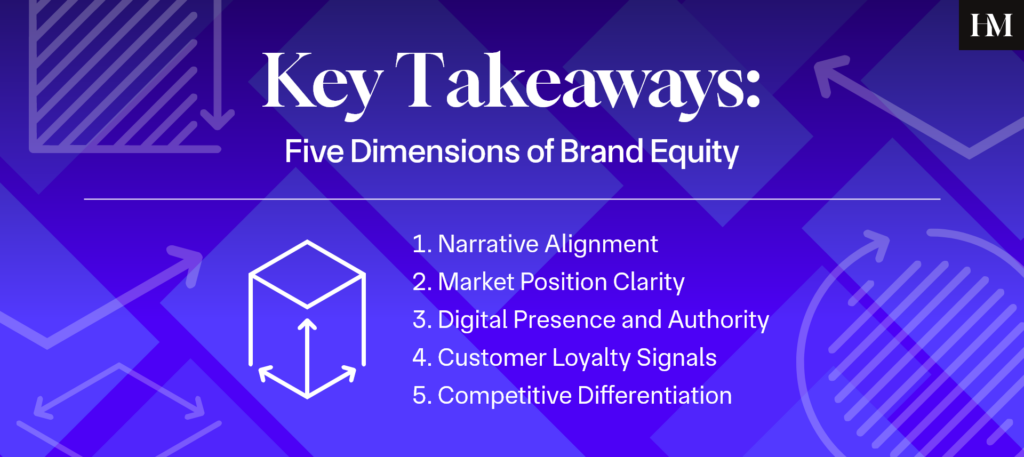
Brand equity is a composite of five measurable dimensions that reveal where your brand stands today and where it can go next.
1. Narrative Alignment: Do Your People Tell the Same Story?
The strongest brands have internal and external consistency. When your leadership team, your sales team, and your customers all describe the business in similar terms, that’s a high-equity brand.
What to look at: Interview five internal stakeholders and five customers. Ask each one the same three questions: What does this company do best? Who is it for? Why would someone choose it over the competition? Compare the answers. The degree of overlap is your narrative alignment score.
What it tells you: High alignment means your brand promise matches market experience. When those answers start to converge, positioning is working. The tighter the alignment, the stronger the foundation for every growth initiative that follows.
2. Market Position Clarity: Can You Articulate Your Competitive Edge in One Sentence?
Brand strength correlates directly with clarity of positioning. Companies that can state, in plain language, what they do differently and why it matters tend to command stronger pricing, shorter sales cycles, and higher close rates.
What to look at: Ask your leadership team to independently write a one-sentence positioning statement. If you get five similar answers from five people, your positioning is landing. That’s a brand asset.
What it tells you: A company with a clear, consistent position is easier for customers to refer, easier for sales teams to pitch, and easier for buyers or investors to evaluate. Research from Bain & Company and Google found that 80–90% of B2B buyers already have a shortlist of vendors before they begin formal research, and 90% of purchases come from that original list. Buyers build that list based on prior experience, peer recommendations, and how clearly a company shows up in the market. Positioning clarity is one piece of that, but it’s the piece you can control most directly and most quickly.
3. Digital Presence and Authority: What Does Your Online Footprint Say About You?
Your website, search visibility, and content quality are the most visible external signals of brand investment. They’re also the first thing a prospective buyer, partner, or customer evaluates.
What to look at: Three specific metrics matter here. First, direct and branded search traffic as a percentage of total site visits (this tells you how many people are looking for you by name, a proxy for brand awareness). Second, content depth and recency across your website and blog (fresh, relevant content signals an active brand). Third, consistency of messaging across all digital touchpoints, from your homepage to your LinkedIn company page to your sales materials.
What it tells you: A company with strong digital presence generates inbound interest, builds credibility before the first conversation, and gives every stakeholder, whether a potential customer, employer, or acquirer, a consistent picture of the business.
4. Customer Loyalty Signals: How Strong Is the Preference You’ve Built?
Brand equity shows up in customer behavior. Repeat purchase rates, referral frequency, willingness to pay a premium, and contract renewal patterns all indicate the strength of preference your brand has built in the market.
What to look at: Retention and renewal rates (especially in B2B), referral volume and source, pricing power relative to competitors, and customer sentiment on platforms like Glassdoor, Google Reviews, or industry-specific forums. Net promoter score is one data point, but the more telling metric is whether your customers proactively recommend you without being asked.
What it tells you: Strong loyalty metrics indicate a brand that’s creating real preference, not just awareness. Companies with measurable customer advocacy carry lower acquisition costs, more predictable revenue, and a stronger negotiating position in any deal context. Every referral is evidence of brand equity at work.
5. Competitive Differentiation: How Visible Is Your Edge?
The final dimension is the simplest to understand and the most directly tied to pricing power. When a prospective customer, investor, or acquirer evaluates your industry, how quickly can they identify what makes you different?
What to look at: Pull up your top three competitors’ websites side by side with yours. Read only the homepage headlines and the “about” language. If you could swap logos and the messaging would still make sense, that’s an opportunity to sharpen your differentiation. Also look at share of voice in your category: how often your company gets mentioned relative to competitors in industry publications, conference lineups, and search results.
What it tells you: Differentiation is the dimension that most directly affects pricing power and deal value. A company with a clearly distinguishable market position commands attention, premium pricing, and stronger interest from buyers and partners. The more visible that edge, the more it compounds across every growth initiative.
Putting the Measurements to Work
These five dimensions, narrative alignment, market position clarity, digital presence, customer loyalty signals, and competitive differentiation, are observable and actionable. Any leadership team can start evaluating them this week.
This list creates a shared language for brand strength that finance teams, operations leaders, board members, and deal teams can all use. When you can point to specific metrics instead of general impressions, brand moves from a subjective conversation to a strategic one.
For companies approaching a transaction, these are the brand signals that inform how buyers and investors evaluate your business. Leadership teams that have already assessed their own brand strength walk into those conversations with better data and a clearer story.
For growth-stage companies, this framework identifies the specific areas where brand investment will generate the clearest return: tighter positioning, stronger digital authority, deeper customer relationships, and a market presence that’s distinctly yours.
Start Measuring Your Brand’s Equity
Brand equity is measurable. Not with a single number, but through a set of observable, trackable signals that indicate how well your brand is performing across the dimensions that matter most.
The companies that understand their brand strength and build on it systematically make better decisions about growth, hiring, partnerships, and transactions. The five dimensions above give you a starting point that’s practical, repeatable, and grounded in what truly drives business value.
Start with narrative alignment. It takes five interviews and a few hours. The overlap between what your team says and what your market hears is the first, clearest indicator of where your brand stands today and how far it can take you.