
Ask most B2B teams what wins their deals, and the answer is usually relationships: the referral, the repeat client, the person who has trusted you for years. That’s real. The harder question is where the next relationship starts, and how you get off on the right foot with a lead who has never met you.
That first impression usually forms before you’re in the room. Sales collateral makes your case: the one-pager, the sales deck, the case study, and the capabilities overview all work to earn the next conversation.
Sales collateral has to work as a sales tool first and a design deliverable second. What separates a piece that wins from one that doesn’t is whether it was built to move a decision.
This article covers what sales collateral is, why it carries more weight than it used to, and five principles for building materials buyers act on.
What Is Sales Collateral?
Sales collateral is any material that helps a buyer understand, evaluate, and choose you: one-pagers, sales decks, case studies, capabilities overviews. Each one supports a specific decision, usually in the hands of someone weighing you against two or three alternatives. Your website carries the same weight when its pages are built to help a buyer decide.
Why Sales Collateral Decides More Deals Than It Used To
Most B2B decisions now happen before you enter the conversation. Research from 6sense on nearly 4,000 buyers found that buyers wait until they’re roughly 61% through their decision before reaching out to a seller for the first time, and 80% of those first conversations are started by the buyer. By then, much of the evaluation has run on the materials you handed over or posted online.
Two shifts shape that early evaluation:
- It’s a group, not a person. 6sense finds the typical B2B buying group now averages 11 people, each arriving with their own research and their own questions.
- The rep is one channel among many. Gartner’s 2025 survey of 646 buyers found 67% prefer a rep-free experience, and 45% used AI during a recent purchase.
Your collateral represents you in every scenario: when a champion makes your case to the rest of the group, when a skeptical finance lead reads it without you there to explain it, and when a buyer researches you on their own schedule, often before anyone on your team knows they exist.
By the time a buyer does reach out, the decision is largely already made. 6sense found that 95% of the time, the winning vendor was already on the buyer’s shortlist before first contact with sales. The materials a buyer gathers early are what put you on that list and keep you at the top of it.
What Makes Sales Collateral Work: Five Principles
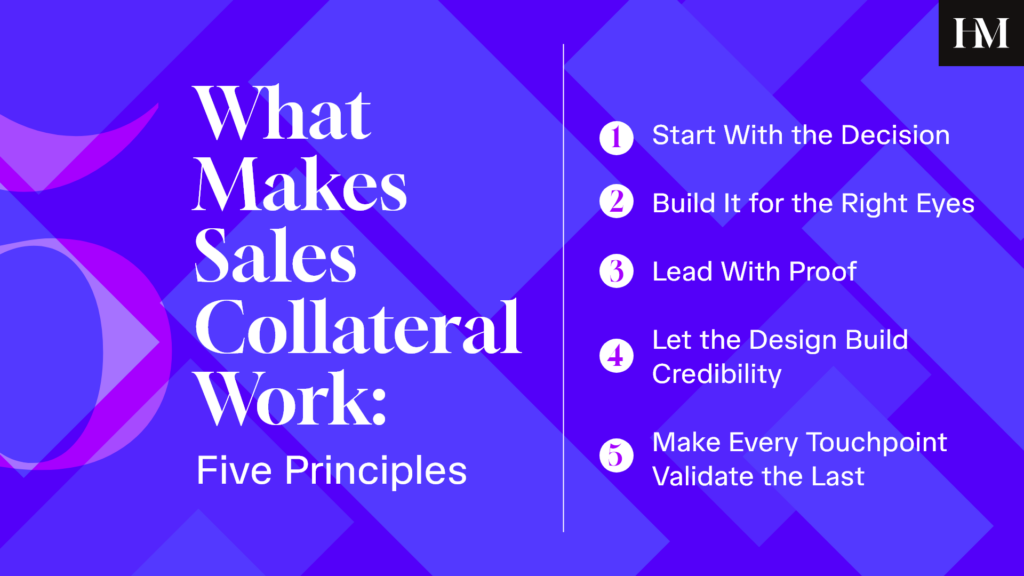
The pieces that hold up under a buyer’s scrutiny, and get forwarded to the rest of the buying group without losing their punch, are built on the same handful of principles every time.
1. Start With the Decision
A sales piece exists to inform a decision, so start with the choice in front of the reader. Work out what the piece needs to accomplish and what the reader should believe when they set it down.
What to look at: Ask what problem sent the reader looking in the first place. What are they trying to solve, and what would they need to believe about you to consider you the answer?
What it gets you: A piece organized around a business outcome where every section points at the decision you are trying to move.
2. Build It for the Right Eyes
The same company needs different collateral for different readers. What belongs in a piece depends on who receives it and what they care about.
What to look at: Ask what matters to this specific reader and what they need to know to feel confident. A finance stakeholder wants proof in numbers, like cost savings, return on investment (ROI), or payback period. An end user wants proof in experience, like ease of use or day-to-day impact.
What it gets you: When their situation is reflected back to them, the reader sees that you understand the problem they’re trying to solve.
3. Lead With Proof
A buyer assumes that if you list a service, you can deliver it. Proof shows the result you produced last time, with a number attached, so the promise rings true.
What to look at: Go service by service and pin each one to a real example. Name the client (or anonymize to a category), describe the situation, and give the measurable result. Replace “trusted by industry leaders” with a specific outcome you produced and the data behind it.
What it gets you: Proof is what a buyer remembers after the meeting, and what a champion repeats to the rest of the group on your behalf.
4. Let the Design Build Credibility
A buyer reads the quality of your materials as a preview of the quality of your work. When the two align, your collateral lets a buyer trust your capabilities before they’ve seen the work firsthand.
What to look at: Set your collateral next to the dollar value and risk of the decision you’re asking the buyer to make. Match the production quality to those stakes.
What it gets you: Good design tells the buyer you bring the same care to your presentation that you bring to the work.
5. Make Every Touchpoint Validate the Last
A buyer’s decision builds across many touchpoints, not one document, so each one needs to reinforce the last. Say a meeting goes well. The buyer will look you up next, and what they find should confirm the story you just told them in the room.
What to look at: Walk the same path a buyer would. Read your one-pager, your website, your LinkedIn page, and then your follow-up email, in the order you’d expect a reader to encounter them. Check whether your company shows up the same way every time, with the same strengths and the same message.
What it gets you: A buyer who keeps finding the same story grows more confident with each step, and arrives at the conversation already leaning toward yes.
Start With One Deal
Pick the next deal on your calendar. Before anyone opens a design file, write down the single decision the buyer needs to make and the three proof points most likely to move it. That one page, the decision and the proof, becomes the brief for everything that follows, and everything you build from it is aimed at winning the work.